
Le jeu de l’amour et du hasard by the French author Marivaux responds to this question with a big 'yes!' The book invites the question: how do animated films, known for their focus on romantic storylines (Tanner et al. 356), tackle this same question, especially considering the unique properties of the animated medium? Such an analysis might give us insight into how animation both reflects and informs real-life narratives on love and distinction – and we might ask ourselves, is this really how we want to utilize animation to explain what love means in relation to someone different from you?
On the surface, many animated films seem to insinuate that dissimilar characters can fall in love. Whereas dissimilarity might be portrayed through gender, class and race in live-action, dissimilarity is often manifested as ‘fantastical,’ ‘other’ beings in animation -- an anthropomorphized, non-human character who doesn’t exist in the real world and who looks radically different from humans but still comes across as human-like. Although not unique to animation, this type of character is more easily depicted through animation compared to other media. All it takes is a different type of character design that fits within the style of a film that already creates the illusion of life from scratch, as opposed to live action where VFX, costumes, etc. would render the same illusion a little more costly and, potentially, silly. Also, since animation is often geared at children, the choice for animated films to use fairy tale beings to convey a notion of “difference” seems to fall well in line with its playful and imaginative audience.
Films with fantastical beings who fall in love with humans include The Little Mermaid (1989) with its mermaid and a prince, Thumbelina (1994) with its elf and a human, Beauty and the Beast (1991) with its beast and a human, and the list continues. The notion of “happily ever after” in these films indicate that the barrier between fantastical and human is not a hindrance for their relationships. But are these characters truly that different from one another? Importantly, all the above-mentioned films have a magical transformation at the end at which point both characters come to belong to the same category, whether human or fantastical. What meaning can we take away from such transformations? And are there animated films in which love cannot overcome distinction?
To explore animated human characters and their romantic relation with “fantastical,” “other” characters, this article analyzes two animated films, Shrek (2001) and Corpse Bride (2005). I demonstrate that although these two films seemingly treat the theme of distinction and love in different ways, both suggest that love can only blossom between beings who are physically and behaviourally alike.
Shrek and Corpse Bride storylines
Shrek begins when the main character, Shrek the ogre, reads a fairy-tale which outlines the story of a princess and her Prince Charming. Shrek concludes that it is stupid and goes outside to take a mud bath. The writer Kristian Moen notes that in a matter of minutes, Shrek presents itself as a film in which “a certain idea of the old-fashioned and sentimental fairy tale becomes the subject of parody and ridicule” (211). In line with this remark, the conflict of the film manifests itself when Lord Farquaard regroups all fairy-tale creatures and exiles them from his kingdom and into Shrek’s swamp. To reclaim his swamp, Shrek accepts to save Princess Fiona from a dragon and bring her back to Lord Farquaard who wishes to marry her. Shrek embarks on the voyage with a donkey who knows how to speak, named Donkey. When they have saved Fiona, Shrek slowly realizes that the more he gets to know her, the more he falls in love with her. At the end of the film, Fiona becomes an ogre and they live “happily ever after” (until the sequel).
Corpse Bride is a stop-motion animated film created by Tim Burton. The critic Steven Allen writes that the story is based on a Russian fairy-tale and that the goal of the film is to disturb the spectator (88). Thus, we see a human character, Victor, who accidentally marries a dead woman while practicing his wedding vows for his fiancée, Victoria, in a forest. He places the ring on the branch of a tree, which we discover is the hand of the “corpse bride,” Emily. He learns that while Emily lived, she ran away with a man who later tricked and murdered her. Since then, she has been waiting for a man to come and fulfil her desire to experience true love. Victor has empathy for Emily but maintains that he loves Victoria. Unlike in Shrek where Fiona and Shrek end up together, Victor does not fall in love with Emily.
The fantastical as a barrier of distinction: Shrek
In the beginning of the film, Shrek uses the fantastical as a tool to create a barrier of distinction between Shrek and Fiona. In an obvious way, this manifests itself in the different physical characteristics of the characters. Shrek is an ogre who is big and has green skin. In contrast, Fiona is human.

Their differences also play out in their behaviour. Shrek displays the manners we might typically associate with an ogre. He is an anti-hero who terrifies humans because he can battle the strongest of humans and win. As a result, humans treat him like a monster. Shrek explains that this is the lot of ogres: “I am an ogre. You know, ‘grab your torch and pitchforks’” (9.51). It is not far-fetched to conclude that he is considered the lowest of the lowest of society. However, Shrek does not care about the opinions of others – he does what he wants. As Donkey remarks, Shrek is the type who says, “I don’t care what nobody thinks of me” (10.17). For example, he farts, burbs and has decided to live alone in a swamp. In addition, he finds rats, living snails, earwax, and eyeballs to be delicious snacks for dinner. These manners indicate that he is no Prince Charming.
Contrary to that, Princess Fiona is a princess awaiting her Prince Charming. She cares a lot about what others think of her. When she learns that Shrek has come to save her from the dragon, she lies down on her bed, fixes some folds in her dress, grabs a flower bouquet and pretends to be asleep – like a real princess waiting for her prince and putting on a show for him. When she walks, it is like she dances delicately and she loves to sing sweet melodies. To summarize, she is seemingly the antithesis to an ogre.
We see that this distinction creates a distance between the two immediately following Fiona’s rescue from the dragon. In this scene, Fiona doesn’t know that Shrek is an ogre—he wears a knight’s armour that covers his face. She believes that Shrek is her “big love” and she tells him that he has to kiss the princess after saving her. Shrek and Donkey make fun of this suggestion and Shrek proclaims, “well, let’s just say I’m not your type, okay?” (0.42.40). In this way, Shrek and Donkey crush the possibility that an ogre and a human could fall in love. Fiona confirms the impossibility of their union when she discovers that he is an ogre a few moments later. She is confused and doesn’t know what to say, except for “this is all wrong” (0.43.16). The fantastical distinction between the two thus signifies for these characters that they are different and that they cannot belong together.
Not only are Fiona and Shrek different from each other—their personalities seem to outright clash and annoy each other. When they first meet, Fiona gives Shrek her handkerchief “as a token of my gratitude” (0.37.10) and in response, Shrek says “thank you,” uses it to clean his face, and gives it back to her covered in dirt. Needless to say, Fiona is not happy. Shrek does not catch that she is courting him in the royal and romantic tradition and just offended her. After Fiona discovers that Shrek is not human, she stops flirting with him, refuses to really hang out with Donkey and Shrek, and keeps saying that she wants a real gentleman. Every time Fiona then talks about love or the idea of a Prince Charming, Shrek gets bored and interrupts her. He affirms his “ogreness” by farting or making fun of Fiona’s royal habits. These gestures highlight what Shrek perfectly summarizes: “She’s a princess and I’m--… an ogre” (1.00.59). In this part of the film, their differences mean that they have no common ground, no reason to fall in love.
The fantastical as a barrier of distinction: Corpse Bride
Corpse Bride also establishes that the two main characters are different because of a fantastical barrier. Like Shrek, Victor and Emily have different physical characteristics that highlight their fictive differences. Victor is a living human, while Emily is dead. The body of Emily is half skeleton, half blue skin.

The film accentuates this distinction between living beings and the dead when Emily brings Victor to the underworld. Victor does not feel at ease and continually repeats that he does not belong in this world with Emily. As he tells her, « there’s been a mistake ! I’m not dead ! » (0.26.48). He proclaims that he is different from Emily because he is a living being and explains that for this reason, they cannot get married. Emily doesn’t want to listen to Victor’s reasoning– she doesn’t think it is so bad that there be a distinction between the two. But even though she says this, the film gives Emily lines which show that she is different from Victor. For example, she remarks that the underworld, « takes my breath away ! Well, it would if I had any ! » (0.27.41). These words remind the audience that she is dead and, per definition, different from living beings. Also, her first thought when Victor suggests that she should meet his parents shows that her experience does not match Victor’s: « meet your parents ! What a fantastic idea ! Where are they buried ? » (0.30.04). Victor has to tell her that they are still alive and this realization has an effect on Emily. Even though she knows Victor is human, it is not until this moment that she begins to acknowledge that, maybe, Victor is too different from her. When they meet another skeleton, her worries are confirmed. He tells them that it is not “natural” that the world of the living should interact with the world of the dead (0.31.41). Thus, the film highlights the improbability of their union.
Like Shrek, distinction also manifests itself in the personalities of Victor and Emily. Victor is very discrete whereas Emily is full of energy. The film accentuates this ironic contrast in its construction of the world of humans and dead. The world of living beings has soft, almost monochromatic colors and lighting. The people are morbid and without joy. For example, at a party organized by Victoria’s parents, no one utters a word. All the guests are old and one man has fallen asleep. In contrast, the world of the dead has all the colors of the palette. Their parties are big and everyone seem to be amused. What’s more, the dead have all ages, from small babies to old skeletons. In this way, Burton constructs the world of the dead as more vibrant than the world of the living. In line with this, when Victor plays the piano in the beginning of the film, Victoria tells him that she cannot play the piano because it is an artform that is « too passionate » (0.09.30). Unlike Victoria, Emily plays the piano without scruples and with emotion. Victor feels more at ease in the world of the living where people are more reserved. He doesn’t know how to act around Emily who has an animated spirit.
In contrast to Emily, Victoria resembles Victor. Even though she belongs to a higher class than Victor and her parents only wants to see them married because Victor comes from a rich Bourgeois family, they have a lot in common. Victor is a tranquil and shy man. He walks cautiously and when his parents tell him to do something, he does as told, even if their demands hurt his self-esteem. For example, when Victor and his parents approach Victoria’s house to meet her for the first time, he shares that he does not feel well because he has never met Victoria. His mother responds, « well at least we have that in our favor » (05.42). Victor simply accepts this remark, even if it is an insult that indicates he is a social disaster. Victoria acts in the same way. She looks at the ground when spoken to, follows the wishes of her parents, and speaks in a soft voice. Finally, whether by coincidence or not, their names are almost the same which really highlights the extent to which Victor and Victoria are alike.
We fall in love with those who resemble ourselves
As Shrek progresses, the film gives the impression that Fiona and Shrek can fall in love, despite their differences. When she must go to the castle where Lord Farquaard lives, Fiona makes up an excuse in order to spend one more night with Shrek and Donkey. During their voyage, she has found a connection with Shrek and as Donkey remarks, they like each other (1.00.16). It is not their differences that make Shrek fall in love with Fiona, though. Shrek’s lines indicate that he loves Fiona despite the fact that she is human (not because of it). For example, he says that he likes Fiona even though she is pretty and thus not ugly like an ogre, which he would prefer (1.04.16). In fact, Shrek does not begin to love Fiona until she starts acting like an ogre, which puts into question whether they have fallen in love with someone different from themselves. On the second day of their travel, Fiona burbs, fights a gang of men, and traps some flies with a spiderweb, like cotton candy, for Shrek to eat. Donkey remarks that she is “as nasty as [Shrek]” (51.43). She stops acting like a princess and this intrigues Shrek. He admits that she is not “exactly what I expected” (51.47). It seems that Shrek falls in love with the characteristics of Fiona that resemble himself.
Fiona also falls in love with someone who resembles herself. Shrek does not know this but Fiona is an ogre at night. She was subject to a spell which cannot be broken but with a true love’s kiss. This is the reason why she acts like Shrek. She is not the typical princess (or human for that matter). When Donkey discovers this, he tells her that she can choose Shrek over Lord Farquaard now because “you know, um, you’re kind of an ogre and Shrek—well, you got a lot in common.” (1.04.16). By saying this, Donkey seems to think that the big differences between Fiona and Shrek are no longer relevant. Now they have a lot “in common.” By the end of the film, Shrek kisses Fiona and she becomes an ogre for good. No longer human, and in fact part ogre the whole time, Fiona belongs to the same fantastical group as Shrek. In this way, the film shows that an ogre and a human cannot work out, but an ogre and an ogre—that’ll work!

In contrast, Victor in Corpse Bride is not a fantastical character in secret, nor is Emily secretly alive. He remains a living being and Emily remains dead. There is also no transformation at the end to convert one of them into the same fantastical/human category as the other. The movie suggests that the love between two characters who come from different worlds (and who remain settled in that world), one fantastical and one human, cannot flourish. Throughout the film, Victor is horrified by the notion that he is married to Emily. He tells her outright: “I’m sorry, but this just can’t work… We’re just too different! I mean, you’re dead!” (0.39.07). He thinks that the distinction between living and dead is too great for love to develop between the two. When he accepts to stay with her in the Underworld, it is only because he learns that Victoria has married someone else and because he pities Emily. The critic Allen remarks that in this way, Victor follows logic instead of his feelings (102).
The film highlights the notion that Victor will try to love Emily in vain by using the symbolism of a butterfly. The first scene of the film shows Victor in the midst of drawing a butterfly trapped inside a glass. After finishing the drawing, he lets it go. The very last shot of the film then shows Emily dissolving into a cascade of butterflies that fly up into the sky, after she and Victor have separated and she decides to find eternal peace. Drawing back to the introduction of the butterfly in the beginning of the film, it can be concluded that if she had stayed with Victor, she would not have achieved this freedom but would have remained the butterfly trapped inside a glass who Victor desperately tries to pin down to understand. This prolepsis signals that it was inevitable that their relation should not work out and that Victor was there to help Emily get out of her trauma and move on. In this way, the film shows that it is best if the distinction between fantastical and human remains intact. Their differences condemn their connection from the get-go.
The value of embracing difference
The only time the film insinuates that, maybe, Victor could fall in love with Emily happens when they connect over their similarities. The scene, named “The Piano Duet,” shows Emily playing piano. She is melancholic because she knows that Victor does not love her. She resembles the people from the living world and does not embody her usual happy mood. She plays the same tune that Victor plays at the beginning of the film, which could signify a bond between the two. Victor is intrigued, sits down next to her, and begins playing a duet with her. Slowly, Emily’s happy character returns and the two play with passion. In this way, they get closer to each other because of their shared interest in music. By the end of the piece, the hand of Emily separates itself from her body and continues playing its own tune. It even runs up all along the arm of Victor. This act highlights, once again, that she is dead. This return to reality could scare Victor and could have put an end to their moment together. But, this time, Emily’s status as ‘dead’ does not bother Victor. When Emily says, “pardon my enthusiasm,” Victor simply responds, “I like your enthusiasm” (0.51.59). Here, Victor accepts Emily as dead—he accepts that she is more passionate than he is, instead of seeing the distinction between them as a fault. He even begins to play the piano as passionately as she does, which could highlight that he learns from her and her different approach to life. Thus, this short but important scene suggests that the love between Victor and Emily could develop and conquer distinction if they were to concentrate on their similarities while, at the same time, embracing their differences.
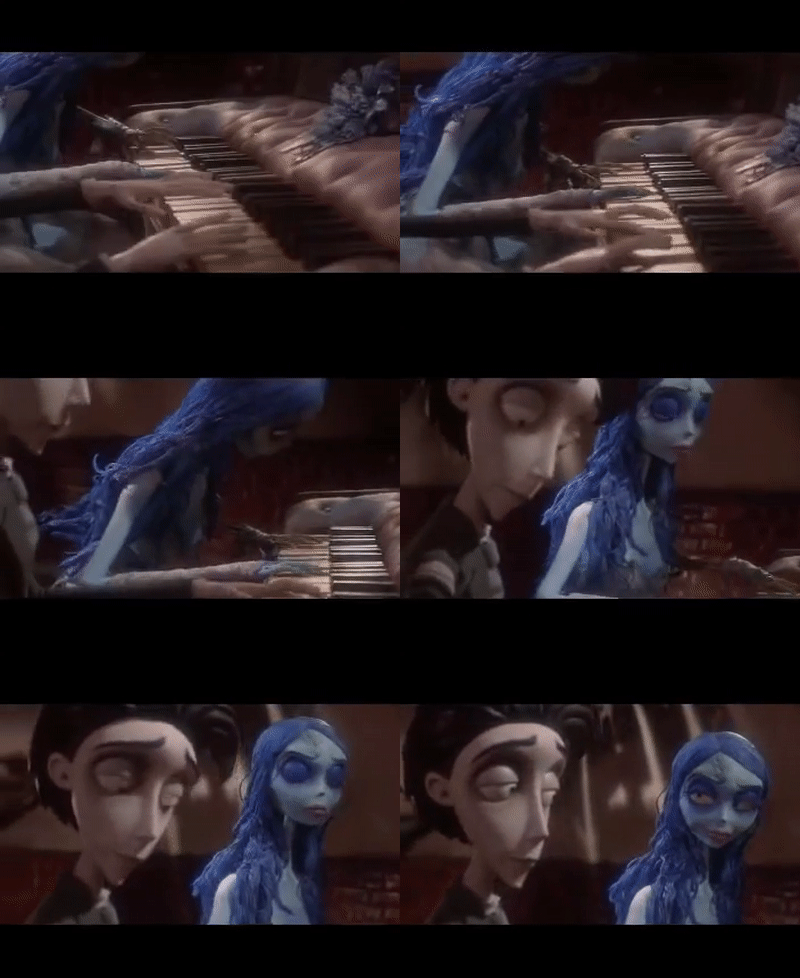
It is possible to conclude that, throughout the film, Emily has represented this mentality. She has loved Victor from the moment she first saw him, despite their differences. It would seem that the notion that people fall in love with those who resemble themselves does not apply to her. However, is Emily’s love for Victor really “love”? Emily says she loves Victor but this love is based on chance. As Allen remarks, she has waited for a man who can replace the love that she was refused by the lover who killed her. This desire is the only reason for her existence in the dead world. Allen says that, “longing for love is the pain of the corpse bride… clearly, any man would do” (101). She uses Victor to reconstruct her lost life. Her love has nothing to do with Victor as a person. In fact, whether he be living or dead, she would have given him her love. She is in love with an image of Victor that only exists in her head and therefore, she is blind to the reality of how different they are. Even if she loves Victor despite their differences, she tries to make it work by ignoring their differences. The end of the film, where the two separate, shows that this type of love cannot win over distinction. It indicates that if you fall in love with someone radically different from you, you have to acknowledge these differences in order to have a long-lasting, truthful relation.
Conclusion
By the end of the film, Corpse Bride has established that Victor is the most attracted to the being who most resembles himself. Emily accepts that Victor does not belong in her world. She tells him, “this is wrong… I love you, Victor. But you are not mine” (1.07.05). She then encourages him to pick Victoria—a human like himself. Victor is relieved by this suggestion. He prefers Victoria. Even though the film has devoted more time to the relation between Victor and Emily, and even though Victor has spent more time with Emily than Victoria, their differences stop their love from flourishing. Victor falls in love with someone who belongs to his own category (human) and resembles him the most in her behaviour, regardless of how well he actually knows her.
Shrek and Corpse Bride thus both address the question of love and distinction. Like the storyline of Le jeu de l’amour et du hasard, no character in neither Shrek nor Corpse Bride fall in love with someone because of “difference.” Deliberately or not, the films display people falling in love based on similarity. Importantly, Shrek shows Fiona transforming into an ogre which seems to indicate that an animated couple where one belongs to a fantastical category and the other to a human category must “become” similar in order for the relationship to work. This division of fantastical and human in relation to love, as found in these two films, invites the study of more animated films to see whether this depiction exists across animated films and which, if any, films show distinctly different characters falling in love despite their differences, with no magical transformations in the end. This would be important to find out to establish a well-rounded understanding of our conceptions of love and distinction and how we wish to convey these through the animated medium.
Works Cited
Allen, Steven. “Bringing the Dead to Life: Animation and the Horrific.” At the Interface / Probing the Boundaries, vol. 61, 2010, pp. 87-107.
Moen, Kristian. Film and Fairy Tales: The Birth of Modern Fantasy. I.B. Tauris, 2012. Ebook.
Tanner, Lisa Renée and Shelley A. Haddock, Toni Schindler Zimmerman, and Lori K. Lund. “Images of Couples and Families in Disney Feature-Length Animated Films.” The American Journal of Family Therapy, vol. 31, 2003, pp. 355-373.
Primary Sources
Shrek. Directed by Andrew Adamson and Vicky Jenson, DreamWorks, 2001.
The Corpse Bride. Directed by Tim Burton and Mike Johnson, Warner Bros. Pictures, 2005.


